DECELERATION TRAINING PROTOCOL
Faster Athletes Need Stronger Brakes.
Every cut, every change of direction, every hard stop runs on braking force. Train the brakes, and your fastest athletes become your most available.

Get The training Protocol.
Sets, Loads, Thresholds, and 35 Peer-Reviewed References.
Brakes Take the Biggest Load. Up to 2.7x Acceleration Force.
High-intensity braking is the most frequent force demand in multi-directional sport. And it arrives in milliseconds [1] — at the limit of what tissue can absorb.
Every Brake Is a Maximal Event.

Up to 104% more decelerations
Athletes perform up to 104% more high-intensity decelerations than accelerations in match play. [1]
2.7x the force of acceleration
Braking loads reach up to 2.7 times the force of acceleration — the heaviest demand your athletes produce. [1]
Under 50 milliseconds
Peak braking force arrives at ground contact, faster than an athlete can consciously react or correct. [1]
32–66% of ACL tears.
Non-contact ACL tears cluster at deceleration — alongside many calf, hamstring, and groin injuries. [2]
Deceleration Training
A vaccine for common injuries
Deceleration is trainable. Controlled exposure to braking loads builds the tissue and mechanics that absorb force.
Researchers describe deliberate deceleration work as a potential "vaccine" against sports-related injury. [3] Turn sport's most dangerous moment into a trained skill.
THE FULL PROTOCOL
Eight Qualities. Seven Machines. One Complete Prescription.
Every part is built to put into programming the first week.

Program against real sport demands. Five force qualities mapped to multi-directional performance. Apply the model to programming decisions, not just theory.
Prescribe loads, reps, and thresholds. Eight training qualities — each with machines, sets, reps, velocity loss thresholds, and rest. Loads set by percent of KOPR and 1RM, ready day one.
Cover every demand and risk site. Seven machines, each mapped to a specific injury risk or performance demand; the A400 Standing Hip and A400 Seated Calf anchor the highest-risk sites — groin, ACL, Achilles.
Draw from 35 peer-reviewed studies. Every claim backed by scientific research. Written by practitioners, for practitioners.
Get The training Protocol.
Sets, Loads, Thresholds, and 35 Peer-Reviewed References.
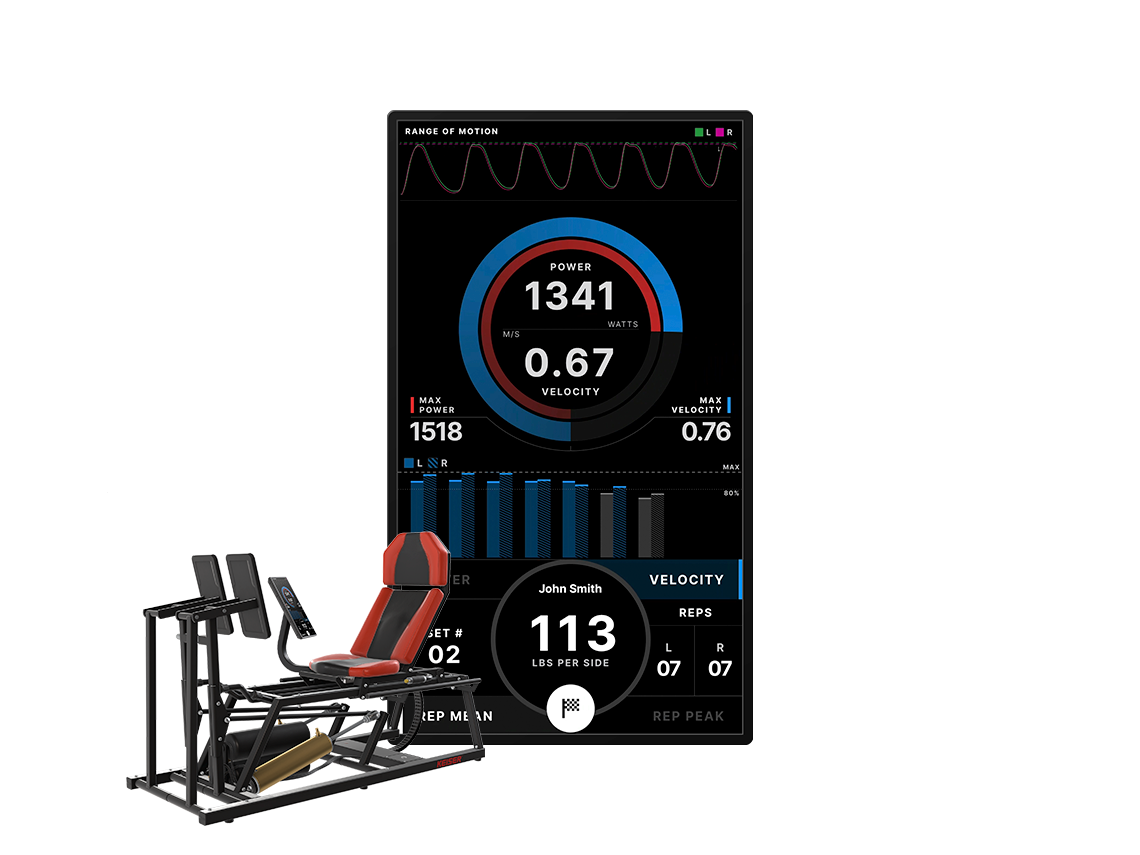
A400 Technology
TEST, TRAIN, AND MONITOR WITH THE SAME MACHINES. RUN THE ENTIRE PROTOCOL ON ONE PLATFORM.
Keiser’s pneumatic resistance carries almost no momentum. A400 machines load the braking system at the velocities of match play — and capture velocity, power, and range of motion on every rep. The data that runs this protocol comes from the same machines that train it.
Detect asymmetries before they become injuries. Independent limb testing across the full load spectrum flags imbalances above the 10–15% injury-risk threshold. [4] Limbs that match at heavy loads can diverge at high speeds.
Match every set to the right stimulus. Velocity loss thresholds end work at the prescribed dose — capping loss at 15% produces superior sprint and COD gains over 30%. [5] The 4-Way Hip and Seated Calf load the three highest-risk sites: groin, ACL, Achilles.
Catch injury signals weeks ahead. Velocity drift at a fixed load reveals fatigue before symptoms appear. Weekly LVP overlays and ROM data surface asymmetry development weeks before injury.
If Your Athletes Decelerate, This Was designed for You.
This protocol is for the Performance Directors, S&C coaches, and sport scientists who build programming — and the physiotherapists who rebuild athletes after injury. It's for the professional, collegiate, and elite youth athletes they prepare, across professional franchises, private academies, and elite programs.
This framework is effective for any multi-directional sport — American football, rugby, hockey, lacrosse, and beyond.
Everything You Need to Program Deceleration.

Complete training prescription table.
Eight training qualities, each with machines, sets, reps, loads, and velocity loss thresholds.
Data integration playbooks.
How to turn velocity, ROM, and profile data into weekly monitoring.
Machine-by-machine rationale.
Why each machine earns its place — with the supporting research behind it.
Multi-facility deployment framework.
How to run the suite across a primary training site and a satellite or match-day site.
Sport demands model.
Five force qualities mapped directly to multi-directional programming decisions.
Coaching staff onboarding plan.
A template for getting your staff fluent on the platform.
Get the Complete Protocol — Free.
The complete evidence-based framework — training prescription, equipment rationale, monitoring playbooks, and 35 peer-reviewed references.
References
1. Harper, D. J., Carling, C., & Kiely, J. (2022). Biomechanical and neuromuscular performance requirements of horizontal deceleration: A review with implications for random intermittent multi-directional sports. Sports Medicine, 52, 2321–2354.
2. Harper, D. J., Philipp, N. M., Eriksrud, O., Jones, P. A., Graham-Smith, P., & Dos'Santos, T. (2025). Assessing deceleration performance: Methodological and practical considerations. Sports Medicine, 55(2).
3. McBurnie, A. J., Harper, D. J., Jones, P. A., & Dos'Santos, T. (2022). Deceleration training in team sports: Another potential "vaccine" for sports-related injury? Sports Medicine, 52(1), 1–12.
4. Bishop, C., Turner, A., & Read, P. (2019). Effects of inter-limb asymmetries on physical and sports performance: A systematic review. Journal of Sports Sciences, 37(10), 1135–1144.
5. Pareja-Blanco, F., Sánchez-Medina, L., Suárez-Arrones, L., & González-Badillo, J. J. (2017). Effects of velocity loss during resistance training on performance in professional soccer players. International Journal of Sports Physiology and Performance, 12(4), 512–519.

Get the Complete Protocol
Contact Commercial Sales